
Meta backs MacroCycle plant targeting 5,000 tons of recycled plastic, 80% lower emissions
Meta has signed a three-year deal with US plastics recycling startup MacroCycle to support development ...
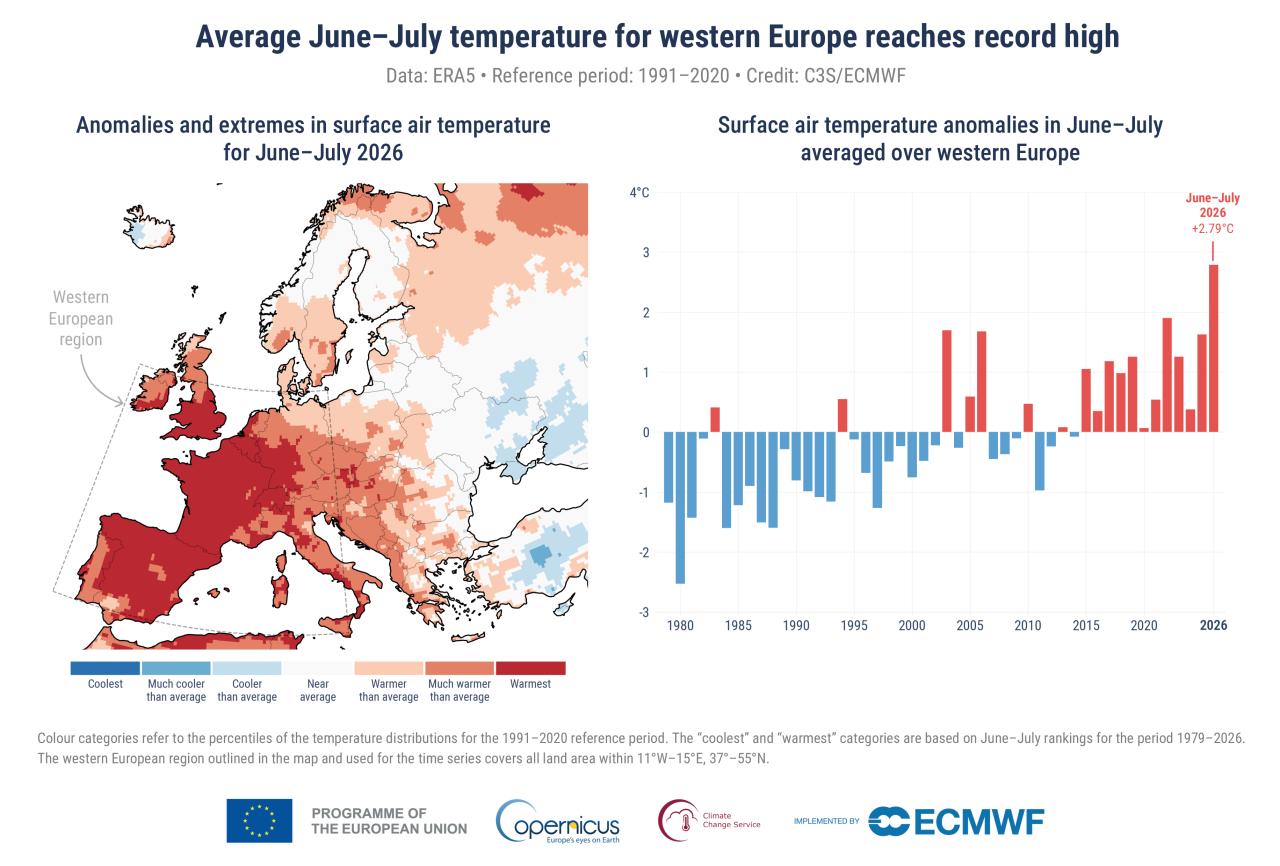
July 2026 ranked as the joint-second hottest July on record globally, as prolonged heat and drought intensified wildfires across western Europe and pushed ocean temperatures to a new July high, according to the Copernicus Climate Change Service (C3S), implemented by the European Center for Medium-Range Weather Forecasts (ECMWF).
The global average surface air temperature reached 16.90°C, 1.47°C above the estimated pre-industrial level and 0.67°C above the 1991-2020 average. July tied with 2024 and trailed only July 2023.
Western Europe experienced its third and fourth heatwaves since May in July, while the average temperature for June and July reached a record 21.62°C, or 2.79°C above average.
“July 2026 was the third consecutive month of exceptional heat in western Europe, bringing the combined temperature for June and July to a new record for the region,” said Samantha Burgess, Strategic Lead for Climate at ECMWF.
“Persistent high-pressure systems trapped heat over western Europe, the extreme temperatures also amplified widespread drought. As soils dry out, they lose their ability to provide natural cooling, allowing heat to build more readily,” she added.
“This is a clear example of how climate change is intensifying heat extremes, with heat and drought increasingly reinforcing one another,” Burgess said.
Dry conditions persisted across much of western Europe, with particularly severe deficits reported in France, Spain, parts of Germany and the UK. The combination of heat and drought contributed to exceptional wildfire activity in terms of both area burned and emissions.
“Last month saw exceptional wildfire activity across western Europe, in terms of the area burnt and emissions,” said Laurence Rouil, Director of the Copernicus Atmosphere Monitoring Service (CAMS) at ECMWF.
“Climate change is increasingly bringing the kinds of hot and dry conditions that favour large, high-intensity wildfires in southern Europe while extending the fire season northwards,” she added.
Extra-polar ocean temperatures hit a record 20.96°C in July, surpassing the previous high of 20.89°C set in 2023.
Tropical Pacific waters remained exceptionally warm as El Niño conditions developed, while record temperatures in the Atlantic and western Mediterranean fueled marine heatwaves around Europe.
Low rainfall and soil moisture contributed to below-average river flows across parts of Europe, putting pressure on water supplies, irrigation, ecosystems, transport and energy production.
Arctic sea ice ranked sixth-lowest for July, while Antarctic sea ice ranked fifth-lowest, according to C3S.
Outside Europe, dry conditions affected parts of North America, Africa, Asia and South America, while wetter-than-average conditions and flooding were reported in several regions.
Meta has signed a three-year deal with US plastics recycling startup MacroCycle to support development ...
Catalyst Mobility, formerly CALSTART, and Smart Freight Center announced that a coalition of major cargo-owning ...
The REEFS Business Incubator, Egypt’s first business incubator dedicated to startups and SMEs working to ...

Leave a comment