
Google sets framework for safer, more accurate healthcare AI
Google has introduced an evaluation framework to assess the safety, accuracy, and usefulness of artificial ...
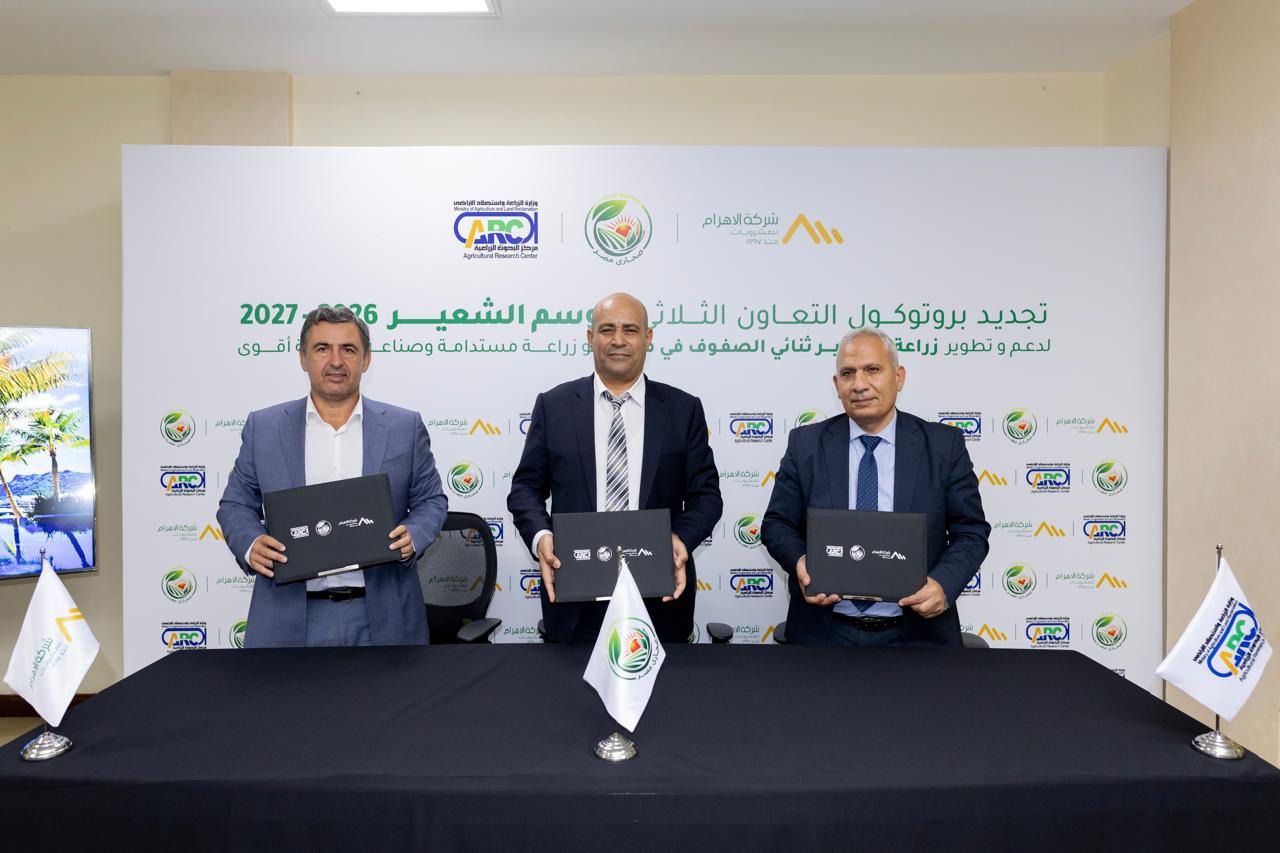
The agreement was signed at ABC’s malt plant in 6th of October City by Nikolay Mladenov, Managing Director of ABC; Mohamed Abdallah, Chairman of Sahara Egypt; and Maher El-Maghraby, Vice President of ARC.
The partnership aims to expand local barley cultivation, improve agricultural resilience, and strengthen domestic supply chains. It also supports ABC’s local sourcing strategy, under which the company relies entirely on locally grown barley and sources more than 90% of its total raw materials from the Egyptian market.
Water savings:
During the 2025/2026 season, the program promoted climate-smart farming practices and improved resource efficiency, generating estimated annual water savings of around 530,000 cubic meters.
It also supported the development of high-quality barley varieties and increased reliance on local production, helping reduce import dependence and the agricultural sector’s carbon footprint.
200 farmers to benefit
The renewed agreement introduces an environmental and social impact pillar designed to extend the partnership’s benefits beyond agricultural development and resource efficiency to farmers and rural communities.
Under the first program, 100 farmers in Fayoum and Kafr El Sheikh will receive 6.5 tons of certified, high-yield barley seeds. The initiative is expected to generate around 200 tons of grain and enable the production of up to 10 tons of green fodder per farmer, potentially increasing household incomes by 25% to 35%.
A second program will support another 100 farmers through knowledge-sharing and capacity-building initiatives. It aims to increase technical knowledge by 30% and reduce post-harvest losses by 15%.
Strengthening local production:
Mladenov said the renewed agreement builds on more than 40 years of cooperation with ARC, which has evolved into a trilateral partnership with Sahara Egypt.
“By bringing together scientific research, agricultural implementation, and industrial application, we have built a local value chain that starts in the Egyptian field and ends with a high-quality product capable of competing regionally and internationally,” he said.
He added that ABC’s reliance on 100% locally grown barley and sourcing more than 90% of its raw materials locally reflect its commitment to supporting Egyptian agriculture, strengthening domestic manufacturing, and creating sustainable economic value.
The company’s malt plant processes locally grown barley to meet domestic demand, with around 40% of its production exported to regional markets, he said.
Mladenov said the new social impact pillar would further strengthen the partnership by supporting smallholder farmers with the knowledge, expertise, and resources needed to improve their livelihoods and expand opportunities across the agricultural value chain.
Research, rural development:
El-Maghraby described the partnership as a successful model of integration between scientific research, agricultural application, and industrial manufacturing, contributing to the development of local barley cultivation in line with the latest scientific principles and sustainable farming practices.
He said the collaboration also supports more efficient natural resource use, environmental protection, improved farmer livelihoods, and rural development.
Abdallah said the results achieved during the 2025/2026 season, particularly in crop production and environmental performance, had demonstrated the value of the partnership and provided a basis for expanding its scope through the new social impact pillar.
He added that the initiative would draw on the three organizations’ expertise to improve the livelihoods of vulnerable families working in agriculture and strengthen the sector’s contribution to the Egyptian economy.
Malt production, exports:
Established in 2005, ABC’s malt plant in 6th of October City is the first and only facility of its kind in the Middle East and North Africa, according to the company.
The plant holds ISO 9001, ISO 14001, and ISO 45001 certifications, as well as FSSC 22000 certification, and is listed on the National Food Safety Authority’s whitelist.
It also recycles malt by-products, including barley rootlets and broken grains, for use in animal feed production.
Google has introduced an evaluation framework to assess the safety, accuracy, and usefulness of artificial ...
Al Ahram Beverages Company (ABC) has renewed its trilateral partnership with the Agricultural Research Center ...
Carbon Gap has launched a free, open-access toolkit enabling governments, researchers and civil society organizations ...

Leave a comment