
Meta backs MacroCycle plant targeting 5,000 tons of recycled plastic, 80% lower emissions
Meta has signed a three-year deal with US plastics recycling startup MacroCycle to support development ...
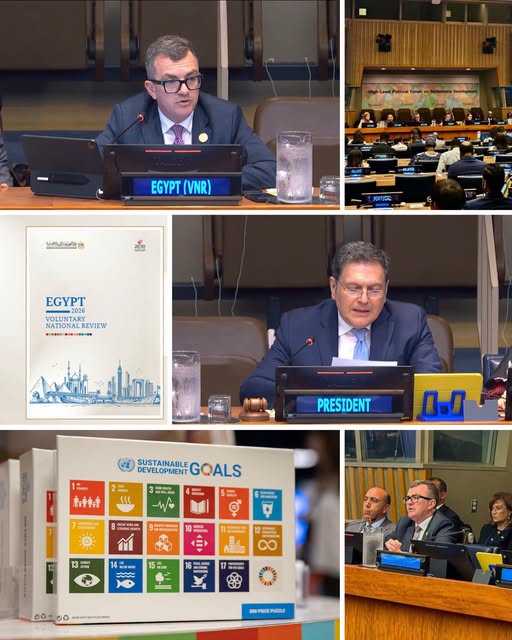
Egypt’s latest Voluntary National Review (VNR) highlights measurable Sustainable Development Goals (SDGs) progress across infrastructure, clean energy and digital transformation, with the country targeting 42% renewable electricity by 2030, securing more than 10 GW of renewable power agreements, improving its global road quality ranking from 118th to 18th, and expanding governorate SDG monitoring by 57%.
The report, presented at the UN High-level Political Forum on Sustainable Development, outlines how Egypt is advancing the Sustainable Development Goals (SDGs) through investments in renewable energy, transport, digital infrastructure, education and institutional reforms, while maintaining a focus on localized development and private-sector participation.
Energy transition remains one of the report’s strongest themes.
Egypt aims to increase renewable energy’s share of electricity generation to 42% by 2030, up from around 13% in 2022, as part of its broader decarbonization strategy. The report identifies the Nexus of Water, Food and Energy (NWFE) platform as a key driver of this transition.
According to the report, the energy pillar of NWFE has already secured more than 10 GW of wind and solar power purchase agreements, while financing has been finalized for more than 5 GW of renewable energy projects backed by over $5 billion in private investment. At the same time, Egypt has permanently retired more than 1 GW of inefficient thermal generation and mobilized around €350 million in concessional financing to modernize the national electricity grid and integrate renewable power.
The report also points to major improvements in transport infrastructure.
Egypt’s ranking in the Global Road Quality Index improved dramatically from 118th in 2015 to 18th in 2024, reflecting years of investment in road networks and logistics infrastructure. Meanwhile, freight handled through Egyptian seaports increased by 43%, rising from 162.8 million tons to 233 million tons, while annual air passenger traffic more than doubled, climbing 129% from 23.8 million to 54.5 million passengers.
The report also highlights East Port Said’s ranking as the world’s third-best performing container port in the World Bank’s 2024 Container Port Performance Index, underscoring Egypt’s growing role as a regional logistics hub.
Digital transformation remains another key pillar of Egypt’s sustainable development agenda.
The ICT sector grew by 14.4% in FY2023/24, followed by 13.8% growth in FY2024/25, making it one of the country’s fastest-growing sectors. Mobile connectivity has also expanded significantly, with 4G coverage reaching 98% of the population and 3G coverage nearly universal at 99.8%. More than 200 digital government services are now available, supported by a nationwide network of 23 digital innovation hubs.
The report records steady gains across several education indicators.
Preparatory school completion increased from 72% to 81%, while secondary school completion rose from 54.3% to 61%. At the same time, average classroom density declined from 47 students per classroom to 38, reflecting continued investment in educational infrastructure.
Beyond sectoral investments, the report highlights efforts to strengthen local implementation of the Sustainable Development Goals.
Governorate-level SDG monitoring expanded by 57%, with the number of localized indicators increasing from 32 to 50, enabling policymakers to better measure development outcomes and tailor interventions to local priorities. The report presents localization as a central pillar of Egypt’s development strategy, helping align national policies with the needs of individual governorates.
Rather than focusing solely on long-term ambitions, the VNR emphasizes measurable outcomes across key sectors. From scaling renewable energy and modernizing infrastructure to expanding digital services and strengthening local governance, the report presents quantitative evidence of progress while outlining the next phase of Egypt’s journey toward achieving the Sustainable Development Goals by 2030.
Meta has signed a three-year deal with US plastics recycling startup MacroCycle to support development ...
Catalyst Mobility, formerly CALSTART, and Smart Freight Center announced that a coalition of major cargo-owning ...
The REEFS Business Incubator, Egypt’s first business incubator dedicated to startups and SMEs working to ...
Leave a comment