
5% of Juhayna’s pink product profits back Baheya’s cancer fighters
Juhayna Food Industries is allocating 5% of the profits from its pink products during October ...
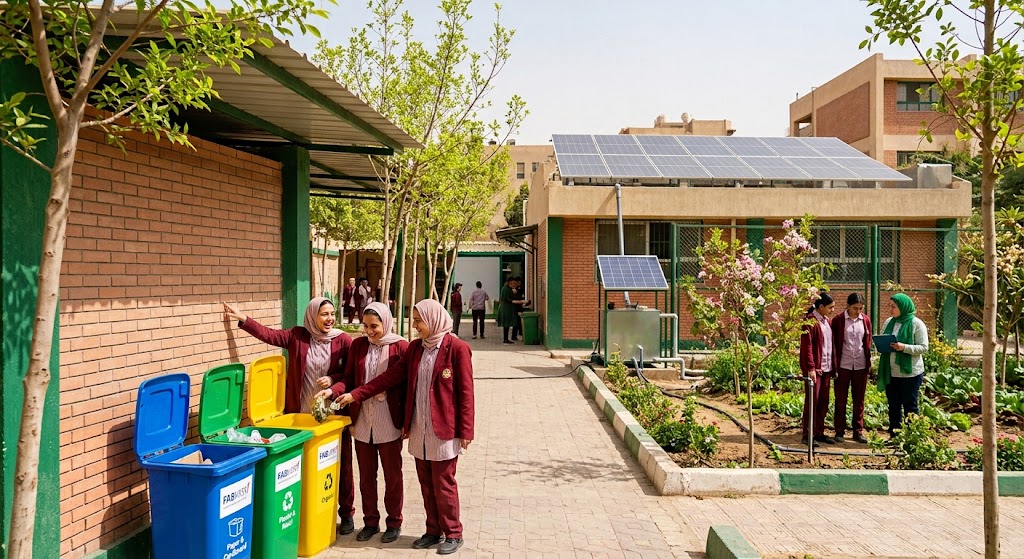
Egypt is stepping up efforts to turn schools into green learning environments, with initiatives spanning solar-powered irrigation, tree planting, waste recycling and climate education to promote sustainable practices among students.
The efforts involve the Ministry of Education and Technical Education, government institutions, banks, civil society organizations and other partners, alongside broader international efforts led by the United Nations Educational, Scientific and Cultural Organization (UNESCO).
Green school infrastructure:
One of the key initiatives is First Abu Dhabi Bank Misr’s (FABMISR) “Green Schools for a Sustainable Future” initiative, launched in collaboration with the Ministry of Education and Technical Education and Ain El Bee’ah Association for Environmental, Agricultural Services and Sustainable Development.
The initiative is being implemented at Asmaa Secondary School for Girls under the Maadi Educational Administration in Cairo Governorate, combining environmental infrastructure, education and community engagement.
The project includes a solar-powered greywater treatment unit for irrigation, a green area featuring tree planting and an integrated irrigation network, as well as waste segregation units for organic and solid waste distributed throughout the school.
The initiative targets around 3,500 students and 150 teachers through environmental awareness programs. It is also expected to lower the site temperature by around 4–5°C, helping mitigate the effects of climate change and creating a healthier learning environment.
Ahmed Mamdouh Hassan, Chief Corporate Governance Officer, Board Secretary and Head of Sustainability at FABMISR, said “Through the ‘Green Schools for a Sustainable Future’ Initiative, we are supporting national priorities under Egypt’s Vision 2030,sustainable developments goals and the Go Green Initiative and investing in education as a driver of long-term environmental and social impact. This project reflects our commitment to developing scalable, measurable models that create real value for communities and future generations.”
Fruitful schools:
Tree planting is another element of Egypt’s green-school efforts.
Shagrha for Sustainable Development launched its “Fruitful Schools” campaign in Mokattam, Cairo. Since its launch in 2016, the campaign has expanded to 22 governorates across Egypt.
The campaign promotes tree planting in schools, with Shagrha acknowledging contributors since its launch.
Green Minds:
The National Institute for Governance and Sustainable Development (NIGSD), in collaboration with the Ministry of Planning and Economic Development, is continuing its “Green Minds” initiative in preparatory schools across Cairo, Alexandria, Fayoum and Ismailia.
The initiative aims to raise awareness of the Sustainable Development Goals, climate change and environmentally responsible behavior among students.
The program includes 18 training days across nine schools, with around 1,600 students participating.
Activities are conducted through experiential learning and interactive games covering responsible consumption of food, water and energy, as well as waste management. The program also addresses gender equality and reducing inequalities.
Students take part in experimental games designed to illustrate the consequences of misconceptions and negative environmental habits, while exploring their role in environmental preservation and societal impact.
The initiative also includes recycling workshops, with students divided into five groups to learn about recycling materials including paper, cardboard and fabric.
Students also participate in workshops to make handmade products, including pencil bags, while artistic panels are created for each participating school.
UNESCO’s green school standard:
Egypt’s initiatives come as UNESCO promotes green schools globally through its Greening Education Partnership.
According to UNESCO, nearly 112,000 schools and higher education establishments in 98 countries have adopted its green-school approach. These include 32,944 nursery schools, 54,292 primary schools, 17,138 secondary schools and 7,535 higher education establishments.
UNESCO’s Green School Quality Standard, published in 2024, establishes minimum requirements for creating green learning environments across four dimensions: governance, facilities and operations, teaching, and local community engagement.
UNESCO is calling on governments and the international education community to reach a target of 50% of schools in every country being green by 2030, while integrating sustainability issues into all school curricula.
Global green education:
The Greening Education Partnership, led by UNESCO, brings together 98 countries and more than 2,000 stakeholders around four areas of action: developing green schools, integrating the environment into school curricula, adapting teacher training to climate change, and promoting green communities.
UNESCO, in partnership with the Islamic World Educational, Scientific and Cultural Organization (ICESCO), has also developed a global tracker covering schools, curricula, teacher capacity and community programs.
ICESCO runs regional competitions and programs in countries across Asia and Africa to promote waste management and water conservation in schools.
At the school level, the green-school approach includes everyday practices such as reducing paper and plastic use, using environmentally friendly school supplies, avoiding unnecessary lighting during the day, conserving water, reporting leaks, reducing waste and separating waste by type for recycling.
Egypt’s initiatives cover several of these areas, from tree planting and recycling activities to environmental awareness programs and infrastructure for more efficient use of water and energy.
Juhayna Food Industries is allocating 5% of the profits from its pink products during October ...
Egypt accounts for 14 entries in Forbes Middle East’s Sustainability Leaders 2026 list, which features ...
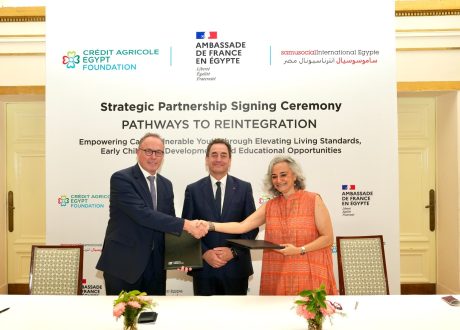
Crédit Agricole Egypt Foundation for Development has partnered with Samusocial International Egypte to improve living ...
Leave a comment