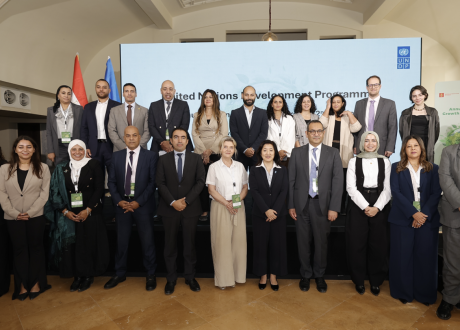
UNDP Egypt Conf. pushes green, digital growth for SMEs, Youth
The United Nations Development Program (UNDP) in Egypt convened its second Annual Green Growth Conference ...
The World Meteorological Organization (WMO) said Europe’s newest weather satellite will make an important contribution to the Early Warnings For All Initiative (EW4All), in particular on the African continent.
“WMO is looking forward to the benefits that this exciting new instrument will provide when the data becomes operationally available to the members. This will make an important contribution to the Early Warnings For All Initiative (EW4All), in particular on the African continent,” said Natalia Donoho, head, WMO Space Systems and Utilization Division.
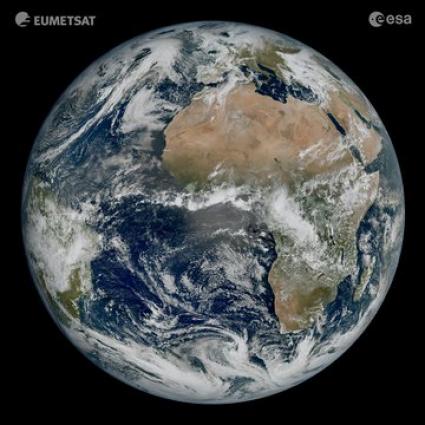
WMO has welcomed the release of the first image from Europe’s newest weather satellite, which reveals conditions over Europe, Africa and the Atlantic with an extraordinary level of detail.
Europe’s meteorological satellite agency, EUMETSAT, and the European Space Agency (ESA) on 4 May jointly released the image from the first satellite in the new generation of European weather satellites, Meteosat Third Generation – Imager 1 (MTG-I1). MTG-I1 was launched on 13 December 2022.
The instruments on the third generation of Meteosat meteorological satellites produce imagery of much higher resolution more frequently than is possible from those on the second-generation spacecraft.
“This remarkable image gives us great confidence in our expectation that the MTG system will herald a new era in the forecasting of severe weather events,” EUMETSAT Director-General Phil Evans said.
“It might sound odd to be so excited about a cloudy day in most of Europe. But the level of detail seen for the clouds in this image is extraordinarily important to weather forecasters. That additional detail from the higher resolution imagery, coupled with the fact that images will be produced more frequently, means forecasters will be able to more accurately and rapidly detect and predict severe weather events,” he said.
“The high-resolution and frequent repeat cycle of the Flexible Combined Imager will greatly help the WMO community to improve forecasts of severe weather as well as long-term climate monitoring, marine applications, and agricultural meteorology. It will provide new information on temporal changes of cloud macro- and microphysics, which are important to capture the fast hydrological processes related to clouds and precipitation formation,” said Donoho.
The United Nations Development Program (UNDP) in Egypt convened its second Annual Green Growth Conference ...
JPMorganChase has pledged approximately $3.5 million to organizations across Greater Boston to expand access to ...
L&G and NTR have secured cornerstone commitments from four returning investors for their second joint ...

Leave a comment