Siemens digital twin targets 20% cut in green hydrogen costs
Siemens, in partnership with Australian solution partner Mescada, is providing digital engineering technology to help ...
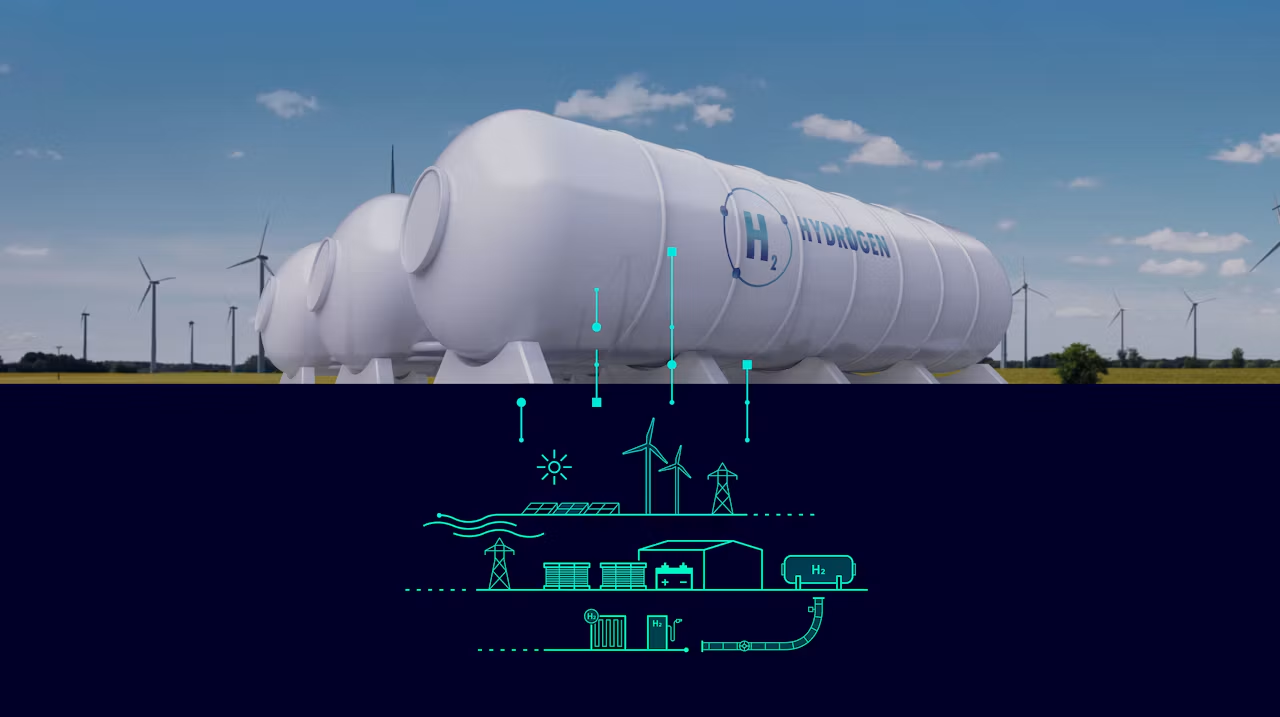
Siemens, in partnership with Australian solution partner Mescada, is providing digital engineering technology to help InterContinental Energy (ICE) optimize its patented P2(H2)Node platform, targeting a reduction of up to 20% in green hydrogen production costs and enabling large-scale deployment.
The project will use Siemens’ gPROMS process modelling and COMOS engineering software to develop a digital twin of ICE’s P2(H2)Node, which integrates hydrogen production with wind and solar power generation. The solution will allow ICE to test different equipment and configurations under varying renewable energy supply and demand conditions, helping determine the optimal design before proceeding to front-end engineering design (FEED) and a final investment decision (FID).
Each P2(H2)Node is designed at gigawatt scale, typically combining 1 to 1.3 gigawatts of AI computing capacity and electrolysis with around 2.6 gigawatts of renewable energy generation.
The project is co-funded by the Australian Renewable Energy Agency (ARENA) through its Advancing Renewables Program, which is contributing $1.56 million towards the total project cost of $3.12 million.
ICE’s Head of Australia Isaac Hinton said the digital twin would enable the company to assess technologies from different suppliers against cost and reliability targets before committing to construction.
He added that the expected cost reduction of up to 20% would also support the development of a repeatable, licensable template for other developers worldwide. The model could help decarbonize AI computing, steel, industrial operations, fertilizers and shipping through large-scale clean energy production.
Under the project, gPROMS will serve as the process-modelling engine within ICE’s broader Python-based optimization and data workflow, while COMOS will provide a controlled engineering-data environment for the standard P2(H2)Node design and its project-specific variations.
The software will manage equipment specifications and documentation and support the development of the basic engineering package, including process flow diagrams and piping and instrumentation diagrams.
Darryl Kaufmann, Managing Director of Digital Industries at Siemens Australia and New Zealand, said the project would allow ICE to digitally design, test and assess costs before construction begins.
He added that energy developers are increasingly seeking digital twins from the earliest feasibility stages, with gPROMS and COMOS providing a unified source of engineering and cost data.
Mescada will coordinate software delivery, onboarding and first-line technical support, while Siemens will provide the underlying technology and escalation support. The partnership is intended to support ICE as its projects move from feasibility studies into engineering and implementation.
Hung Chan, CEO of Mescada, said the company had brought gPROMS and COMOS together to integrate process modelling, engineering data and cost information, supported by training and ongoing technical assistance.
He added that the project marked an important step in applying Siemens technology to gigawatt-scale energy developments.
Siemens, in partnership with Australian solution partner Mescada, is providing digital engineering technology to help ...
The UAE’s Commercial Bank International (CBI) has partnered with Boomitra to give customers access to ...
Al Ahram Beverages Company (ABC) and Orange Corners Egypt have supported more than 340 startups ...

Leave a comment