
5% of Juhayna’s pink product profits back Baheya’s cancer fighters
Juhayna Food Industries is allocating 5% of the profits from its pink products during October ...
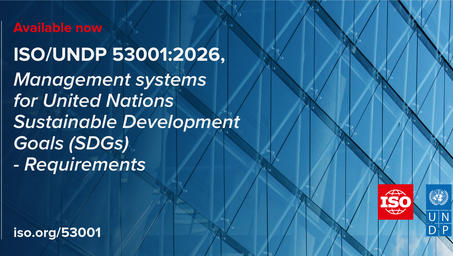
The International Organization for Standardization (ISO) and the United Nations Development Program (UNDP) have launched ISO/UNDP 53001, the world’s first International Standard designed to help organizations turn Sustainable Development Goals (SDGs) commitments into measurable action.
The standard provides a structured framework for embedding sustainability priorities into organizational strategy, governance and day-to-day operations, helping businesses, governments, educational institutions, civil society organizations and others measure progress and strengthen accountability.
Turning sustainability commitments into action:
ISO/UNDP 53001 enables organizations to identify their sustainability priorities, set objectives, integrate them into existing processes and measure performance over time.
As a requirements-based management system, the standard provides a consistent approach to demonstrating that organizations’ sustainability efforts meet defined requirements, while supporting continual improvement.
Organizations can apply the standard to the SDGs most relevant to their operations and stakeholders, making it adaptable across sectors and geographies.
ISO Secretary-General Sergio Mujica said the launch supports organizations seeking practical ways to advance the SDGs.
“The SDGs have provided a shared global vision for a decade. Today, organizations are looking for concrete ways to translate that vision into action,” Mujica said.
“International Standards have long helped organizations address complex global challenges by providing a common language and a shared framework for action. We are delighted to launch ISO/UNDP 53001 today, extending this proven approach to the SDGs and helping organizations create positive impact for people and planet.”
A common framework for sustainable development
UNDP identified ISO as its international standards development partner, combining the UNDP’s sustainable development expertise with ISO’s global standardization system and network of national standards bodies.
Marcos Neto, UN Assistant Secretary-General and Director of UNDP’s Bureau for Policy and Programme Support, said organizations across sectors have a role to play in advancing sustainable development.
“The SDGs provide a shared blueprint for a more inclusive and prosperous future. Achieving that requires organizations everywhere to turn ambition into action,” Neto said.
“We are proud to launch ISO/UNDP 53001 alongside ISO as a crucial tool to help organizations embed the SDGs into the way they operate, lead and govern. By making sustainability part of everyday decision-making, the standard can help accelerate progress towards the 2030 Agenda.”
Built for long-term sustainability goals
Jens Heiede, Chief Executive Officer of Danish Standards, said developing the first International Standard dedicated to the SDGs required international collaboration across sectors and perspectives.
“Creating a standard that could be applied by organizations of every size, sector and geography required extensive collaboration between experts from around the world. Together, we developed a practical and internationally agreed set of requirements that organizations can apply with confidence,” Heiede said.
“It has been a privilege for Danish Standards to lead the technical committee behind ISO/UNDP 53001. We look forward to seeing organizations use the standard to demonstrate accountability and deliver meaningful sustainability outcomes.”
Designed for long-term use, ISO/UNDP 53001 can support the current SDGs and future global goals, with ISO’s regular review process helping ensure it remains relevant and fit for purpose.
ISO and UNDP will work with partners to support implementation, including sector-specific guidance linking global sustainability priorities with industry and market realities.
Juhayna Food Industries is allocating 5% of the profits from its pink products during October ...
Egypt accounts for 14 entries in Forbes Middle East’s Sustainability Leaders 2026 list, which features ...
Crédit Agricole Egypt Foundation for Development has partnered with Samusocial International Egypte to improve living ...

Leave a comment