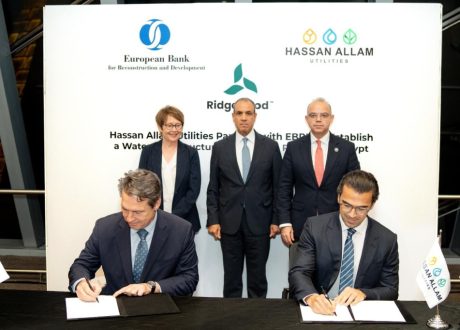
EBRD, Hassan Allam invest $92 mln in water desalination, energy efficiency
The European Bank for Reconstruction and Development (EBRD) and Hassan Allam Utilities are investing a ...
A $150 million fund targeting textile, apparel and footwear suppliers in emerging markets aims to cut 3 million tons of carbon dioxide equivalent emissions over 10 years by financing energy-efficiency upgrades, renewable energy installations and water conservation projects.
The Decarbonization of Textile, Apparel, and Footwear Suppliers (D-TAFS) fund is managed by impact investor and asset management firm SIMA Funds in partnership with the International Finance Corporation (IFC), a member of the World Bank Group.
Inditex, the owner of Zara and the world’s largest fashion retailer, has committed $50 million as an anchor investor, while IFC has contributed $60 million. The fund also brings together other development finance institutions, institutional investors and global apparel brands.
The Global Environment Facility (GEF) has committed $13.8 million in concessional financing to the fund’s riskiest tranche, helping absorb potential losses and reduce investment risks for other participants.
The financing structure brings together investors with different levels of risk exposure. Development finance institutions and institutional investors occupy the senior tranches, while global apparel brands, including Inditex, contribute to a junior tranche. The GEF’s catalytic financing sits at the bottom, absorbing potential losses before senior investors in the event of loan defaults.
This risk-sharing mechanism helped secure commitments from IFC, other development finance institutions and private investors, making the initiative commercially viable.
The fund will provide long-term loans to supplier factories in emerging markets, many of them small and medium-sized enterprises, to finance energy-efficiency improvements, renewable energy installations and better water management, while helping eliminate hazardous chemicals from production processes.
Over its 10-year life, D-TAFS aims to support at least 60 borrowers, reduce 3 million tons of carbon dioxide equivalent emissions and improve the lives of 150,000 workers, most of them women.
The initiative focuses on supplier factories, which account for the bulk of apparel brands’ Scope 3 emissions — indirect emissions generated across their value chains. Cutting emissions at the supplier level is therefore critical to helping fashion brands meet their climate commitments.
In addition to its investment in the fund, the GEF is providing a $917,000 grant for technical assistance to improve hazardous chemicals and waste management across supplier factories.
The grant will help around 100 factories identify opportunities to reduce hazardous chemical use, transition toward a Preferred Chemicals List covering approximately 1,300 high-use chemicals, and train employees to adopt safer alternatives.
The technical assistance will also support the Minamata Convention by reducing mercury in supply chains.
The overall GEF financing package, including agency funds, totals $16 million and is expected to mobilize more than $150 million in co-financing.
The D-TAFS structure could be replicated across the fashion industry and other supply chains, including electronics and food, where large buyers depend on networks of smaller suppliers and indirect emissions represent a significant share of their environmental footprint.
The initiative builds on the GEF’s broader efforts to combine private-sector investment with environmental financing in agriculture, electronics, small-scale gold mining and tourism.
Programs such as planetGOLD, FARM, iCOAST and GEM use blended finance instruments to attract private capital to projects addressing environmental challenges.
Through D-TAFS, the GEF aims to demonstrate how concessional financing can reduce investment risks, mobilize private capital and accelerate environmental progress across global supply chains.
The European Bank for Reconstruction and Development (EBRD) and Hassan Allam Utilities are investing a ...
Egypt is boosting its appeal to global supply chains through infrastructure investment, streamlined regulations and ...
L’Oréal Paris hosted its “Women for Worth” event in front of the Pyramids of Giza, ...


Leave a comment