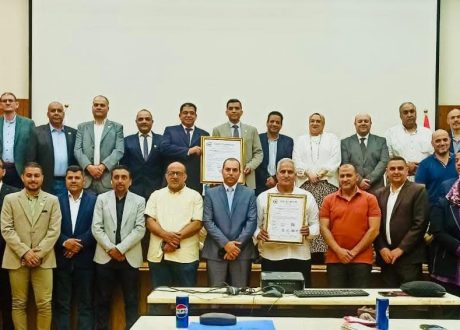
“وزير الزراعة” يعلن حصول الحجر الزراعي المصري على شهادة الأيزو لأول مرة
أعلن علاء فاروق، وزير الزراعة واستصلاح الأراضي، حصول الإدارة المركزية للحجر الزراعي على شهادة الأيزو ...
The World Economic Forum’s Global Gender Gap Report 2025 revealed that women outpace men in higher education but only 28.8 % reach senior leadership.
The global gender gap has closed to 68.8%, marking the strongest annual advancement since the COVID-19 pandemic. Yet full parity remains 123 years away at current rates, according to the report. Iceland leads the rankings for the 16th year running, followed by Finland, Norway, the United Kingdom and New Zealand.
The 19th edition of the report, which covers 148 economies, reveals both encouraging momentum and persistent structural barriers facing women worldwide. The progress made in this edition was driven primarily by significant strides in political empowerment and economic participation, while educational attainment and health and survival maintained near-parity levels above 95%. However, despite women representing 41.2% of the global workforce, a stark leadership gap persists with women holding only 28.8% of top leadership positions.
“At a time of heightened global economic uncertainty and a low growth outlook combined with technological and demographic change, advancing gender parity represents a key force for economic renewal,” said Saadia Zahidi, Managing Director, World Economic Forum. “The evidence is clear. Economies that have made decisive progress towards parity are positioning themselves for stronger, more innovative and more resilient economic progress.”
Iceland maintains its position as the world’s most gender-equal economy for the 16th consecutive year, with 92.6% of its gender gap closed – the only economy to surpass 90% parity. Finland (87.9%), Norway (86.3%), the UK (83.8%) and New Zealand (82.7%) round out the top five positions. All top 10 economies have closed at least 80% of their gender gaps, the only economies to achieve this milestone. European nations dominate the top 10 rankings with eight positions – Iceland, Finland, Norway and Sweden have maintained top 10 status since 2006.
The index looks only at gender gaps in outcomes and not at the overall levels of resources and opportunities in a country. It finds a slight correlation between the current income levels of the countries covered and their gender gaps, with richer economies being slightly more gender equal. At the aggregate level, high-income economies have closed 74.3% of their gender gap – slightly higher than the averages observed in lower income groups: 69.6% among upper-middle income, 66.0% among lower-middle-income and 66.4% among low-income economies.
Northern America leads the world with a gender parity score of 75.8%, showing particularly strong performance in economic participation and opportunity (76.1%) where it leads all regions. The region has made significant progress in political empowerment since 2006, narrowing its political parity gap by 19.3 percentage points.
Europe ranks second with a gender parity score of 75.1%, having closed 6.3 percentage points of its overall gap since 2006. The region has particularly strong performance in political empowerment (35.4%) where it ranks highest globally. European economies continue to lead the overall rankings, occupying eight of the top 10 positions.
Latin America and the Caribbean stands out as the region with the fastest rate of progress, ranking third with a score of 74.5% and having advanced 8.6 percentage points since 2006 – making the greatest overall progress of all regions. This regional success demonstrates that rapid progress is achievable with focused policy interventions, offering a model for economic acceleration through gender parity.
Central Asia places fourth with a score of 69.8%. Armenia (73.1%) and Georgia (72.9%) are the region’s top performers, each closing more than 70% of their gender gaps and leading regional progress in economic participation and educational attainment.
Eastern Asia and the Pacific ranks fifth with a score of 69.4%, achieving the second-highest regional score for economic participation and opportunity at 71.6%. New Zealand (82.7%), Australia (79.2%) and the Philippines (78.1%) are the top performers in the region, with New Zealand the only economy from the region in the global top 10.
Sub-Saharan Africa ranks sixth with a score of 68.0%. The region displays wide variation across countries, yet its success stories demonstrate that progress is possible in all economic contexts. The region has made significant progress in political empowerment, with women now holding 40.2% of ministerial roles and 37.7% of parliamentary seats.
Southern Asia ranks seventh with a score of 64.6%. Bangladesh (77.5%) is the region’s top performer, and the only Southern Asian economy in the global top 50. Significant improvements in educational attainment since 2006 are creating a foundation for future economic gains.
Middle East and Northern Africa ranks eighth with a score of 61.7%. However, the region has shown considerable improvement in political empowerment since 2006, with the regional average more than tripling and gaining 8.3 percentage points on this dimension.
“Women’s progress in leadership continues to decline. As the global economy transforms, AI accelerates, and countries look to combat stagnating growth, this leadership gap should set alarm bells ringing,” said Sue Duke, Global Head of Public Policy, LinkedIn. “The varied experience and uniquely human skills that women bring to the leadership table are essential to unlocking the full promise of an AI-powered economy, yet are being overlooked at exactly the moment they are needed most.”
The path to leadership is less and less linear for workers overall, but especially for women. LinkedIn data reveals that it is now over twice as common for leaders to have worked in at least two different industries, functions or companies – suggesting both greater adaptability and potential barriers to linear advancement within single sectors.
Career breaks are at the heart of this dynamic, with women being 55.2% more likely to take them than men. Women also spend on average half a year more than men away from work, with caregiving responsibilities driving most of these interruptions. This shift from rigid career ladders reflects the reality of modern work patterns, where lateral moves, sector transitions and re-entry after breaks are becoming the norm rather than the exception.
أعلن علاء فاروق، وزير الزراعة واستصلاح الأراضي، حصول الإدارة المركزية للحجر الزراعي على شهادة الأيزو ...
تابع المهندس شريف الشربيني، وزير الإسكان والمرافق والمجتمعات العمرانية، سير العمل بعددٍ من مشروعات المرافق ...
أكد الدكتور أحمد السبكي، رئيس الهيئة العامة للرعاية الصحية، أن الهيئة تبنت 7 ركائز رئيسية ...

اترك تعليقا