
e& Business, Horizon Egypt partner on smart city infrastructure for SA’ADA New Cairo
e& Business, the enterprise arm of e& Egypt, has signed a strategic partnership with Horizon ...

The International Air Transport Association (IATA) will soon launch CO2 Connect for Cargo to support accurate emissions calculation and reporting, including SAF usage.
The air cargo industry continues to embed sustainability into its operations, with growing efforts to reduce waste, implement circular practices, and phase out single-use plastics. For example, IATA guidance to eliminate single-use plastics across the cargo supply chain is now reflected in operational standards.
Progress is also being made on the sector’s largest environmental challenge—reducing carbon emissions. Momentum around Sustainable Aviation Fuel (SAF) is growing, with new agreements across the value chain and more companies committing to SAF use. The SAF Registry, recently launched and operated by CADO, is designed to enable a global market for Sustainable Aviation Fuel (SAF) and accelerate the industry’s transition to net-zero emissions by 2050.
However, SAF volumes remain far below what is needed, and production costs remain high. IATA urged governments to implement policy frameworks to scale up SAF production and reduce costs.
“We are committed to net zero carbon emissions by 2050. But the ramp-up of SAF—our strongest lever—has been disappointing. The major fuel producers have been slow-walking—or sidelining—planned investments in SAF. Aircraft manufacturers have backed off their commitments for medium-term delivery of CO2 saving products such as hydrogen-powered aircraft. And governments have not provided the policy support needed, even though they have a playbook at hand with how the wind and solar energy industries expanded. Instead, they send mixed signals by subsidizing fossil fuel extraction while aiming for net zero. Airlines are committed and determined but we cannot do it alone. We need action behind the words of regulators, fuel suppliers and manufacturers,” said Sullivan.
“Whether supporting global trade, enabling e-commerce, or delivering vital humanitarian aid, the value of air cargo has never been clearer. To meet customer expectations and navigate an increasingly complex environment, the air cargo industry must continuously strengthen safety and security, fast-track digitalization, and deliver on its sustainability commitments,” said Brendan Sullivan, IATA’s Global Head of Cargo at the opening of the 18th World Cargo Symposium (WCS) in Dubai, UAE.
e& Business, the enterprise arm of e& Egypt, has signed a strategic partnership with Horizon ...
OPPO increased renewable electricity use across its manufacturing operations to nearly 70% in 2025, expanded ...
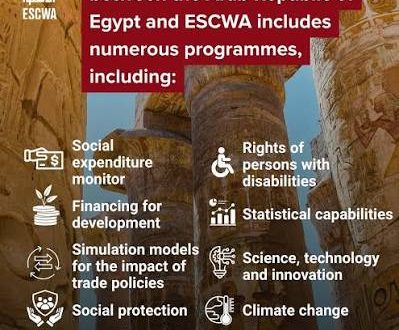
The United Nations Economic and Social Commission for Western Asia (ESCWA) reaffirmed its commitment to ...

Leave a comment